
Crafting
Chronkeeper’s crafting is a frame, not a rulebook. You decide what exists, what it takes, and how long it sits on the bench. A healing potion can be one afternoon’s work; a legendary blade can be a season of prep sessions, rare metals and waiting. Both are built the same way.
Crafting tools are part of the Adept plan.
There are three pieces, and it is worth knowing how they fit before you start:
| Piece | What it is |
|---|---|
| Ingredients | Your world’s raw materials, as a reference list |
| Recipes | What an item takes, broken into stages you define |
| Projects | One character actually making one item, tracked against the clock |
1. Define your ingredients
Open Crafting → Ingredients and choose to add one. An ingredient needs a name and a type:
fluid · plant · metal · gem · stone · hide · cloth · bone ·
essence
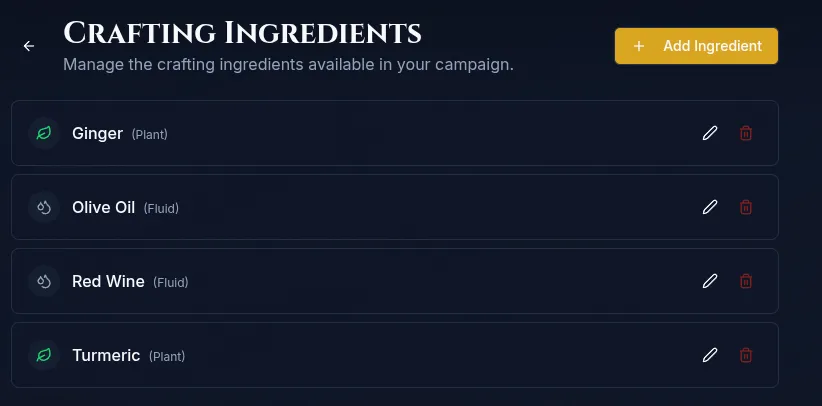
Add the things your world is made of: Moonpetal, Cold Iron, Basilisk Hide, Ghostcap Spores. Types keep a long list sorted and let a herbalist’s shelf read differently from a smith’s.
This list is your reference, and the same names feed your crafting loot tables, so what the party finds in a hoard is what your recipes ask for. Note that Chronkeeper does not track who is carrying which ingredient: material names are written as text on a recipe stage, and whether the party has them is your call at the table.
2. Set up categories (optional)
Crafting → Categories holds the kinds of thing that can be made: Potion, Armour, Weapon, Wondrous Item. Categories are shared across your campaigns and only sort your recipe list, so you can skip this and come back later.
3. Create a recipe
Go to Crafting → Recipes and add one. A recipe has:
- Name: Potion of Healing, Sunsteel Greatsword
- Category: from the list above
- Rarity: Common through Legendary, whatever your world uses
- Description (optional): what it does, what it looks like, what the smith mutters while making it
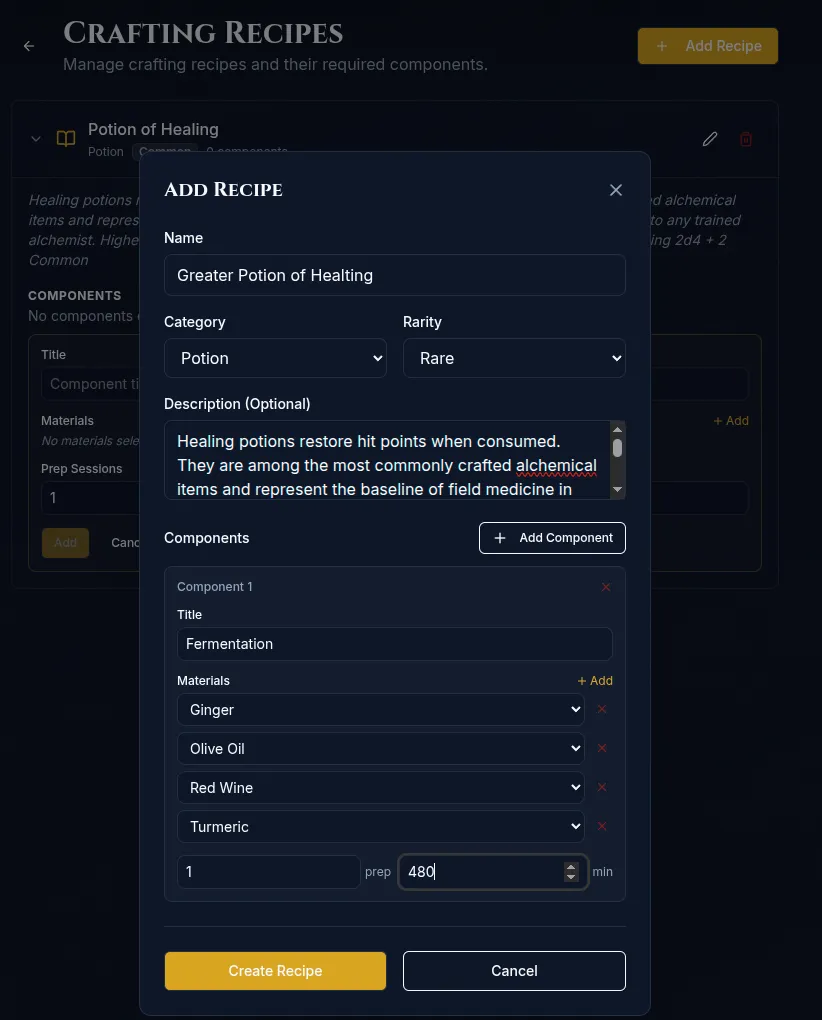
Rarity here is a label for your own sorting. It doesn’t change the work; the stages below do that.
4. Break the recipe into stages
This is where crafting becomes yours. A recipe is a list of Components: ordered stages, each with its own materials and its own cost in time. They are the benchmarks your players work through, and you decide how many there are.
Each stage has four fields:
| Field | What it means |
|---|---|
| Title | The stage, e.g. Quench the blade, Steep the petals |
| Materials | What this stage consumes, as a comma-separated list |
| Prep Sessions | How many separate working sessions the stage needs |
| Bake Time (min) | Unattended time after the prep is done, in in-game minutes |
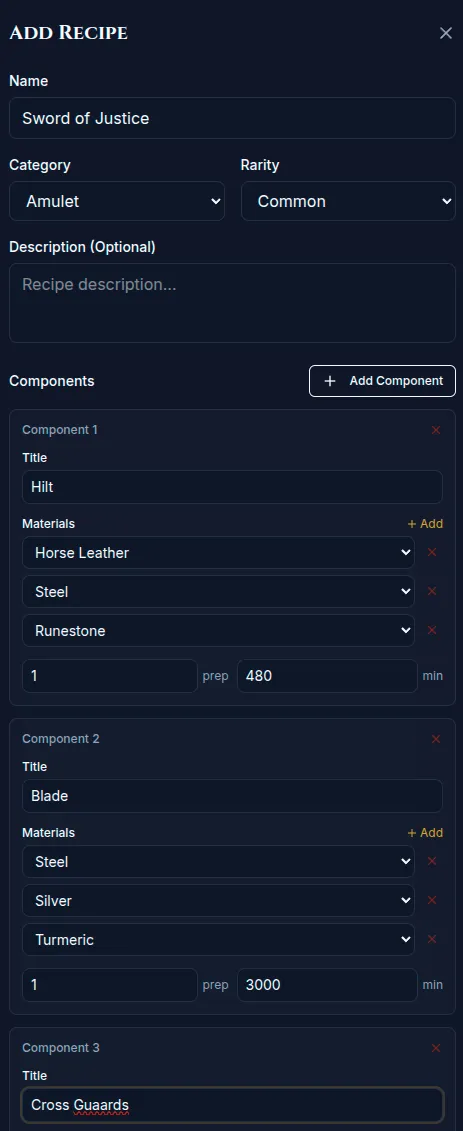
The two time fields do different jobs, and using both is what makes a legendary item feel legendary:
- Prep sessions are the character’s hands-on work. Each one is recorded by you as it happens, usually over a long rest, so a stage needing three prep sessions spans at least three rests of downtime. Progress estimates count a prep session as two hours of work.
- Bake time is the waiting: the steeping, the cooling, the curing. It ticks down on its own as the campaign clock advances, whether the party is in town or three days into a swamp.
A stage with no bake time finishes the moment its prep is done. A stage with no prep is pure waiting.
Two shapes of recipe:
Potion of Healing, one stage and an afternoon:
| Stage | Materials | Prep | Bake |
|---|---|---|---|
| Steep and strain | Moonpetal, spring water | 1 | 60 min |
Sunsteel Greatsword, four stages and most of a season:
| Stage | Materials | Prep | Bake |
|---|---|---|---|
| Smelt the sunsteel | Sunsteel ore, dragon coal | 3 | 480 min |
| Forge the blank | Smelted ingot | 4 | 0 |
| Quench and temper | Basilisk blood | 2 | 1440 min |
| Set the hilt gem | Star sapphire, gold wire | 1 | 120 min |
Same tool, two very different pieces of downtime. Nothing stops you putting a twelve-stage ritual in front of a player who has earned it.
5. Start a project
A recipe is the plan; a project is a character making the thing.
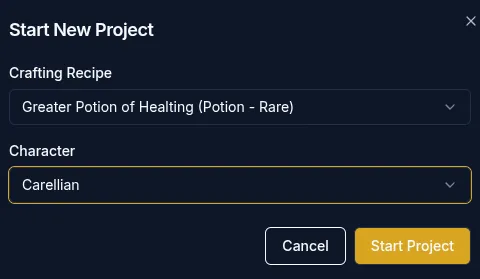
Open Campaign Manager → Projects, start a new project, and choose the character and the recipe. Chronkeeper copies the recipe’s stages onto the project, so later edits to the recipe don’t rewrite a build already underway. The character’s first prep session on the first stage is counted as they begin.
6. Work the stages, and let the clock do the rest
From the project, you record a prep session each time the character spends their downtime on it. When a stage has all the prep sessions it needs, it moves on to baking; when its bake time runs out, the stage is done and the next one begins.
Bake time only moves when your campaign’s clock does. Record a long rest, a journey or any other event, and every baking project in the campaign advances by the same amount.
7. Chronkeeper tells you when something is done
You don’t have to watch the projects list. When you advance the clock and that advance finishes a stage or an item, Campaign Manager shows a Crafting Complete! panel naming what finished, so you can tell the table that the blade came out of the quench while they were on the road.
This is a notice inside the app at the moment you move time forward. There are no emails, no push notifications, and nothing arrives while you are away from Chronkeeper.
What crafting does not do
- No inventory. Chronkeeper doesn’t track which character is carrying which ingredient, or subtract materials when a stage begins. It tracks the work and the time; the materials stay a matter for your table.
- No rules enforcement. Nothing checks proficiency, tool kits, or whether a level 2 wizard should really be forging a sunblade. If you allow it, it happens.
- Ingredient names are text. A recipe stage’s materials are typed, not linked to your ingredient list, so a typo won’t be caught for you.
What next
- Stock your crafting loot tables so the party can find these ingredients in the wild.
- Add the finished item to a roll table if you want it to show up in another campaign’s hoard.